Men's health · Expectations
How Long Do Prostate Supplements Take To Work?
The honest timeline, taken from the trials themselves rather than from a sales page, plus a simple way to measure whether anything is actually changing.
Plan on 8 to 12 weeks, not days. The human trials behind these ingredients ran 4 to 26 weeks for beta-sitosterol, an average of 64 days for pygeum, and a full 6 months for nettle root. Night-time urinary frequency and stream strength are the outcomes that moved, and they moved gradually.
Before you read on
I am not a doctor, urologist or pharmacist. I write from published research. See your own doctor before you start or stop any supplement, and get any urinary or prostate symptom checked in person.
Some links on this site are affiliate links. If you buy through one of our review pages we may earn a commission, at no extra cost to you. It does not change what the studies say or what we write here.
How long did the actual studies run?
Between one month and six months, with the strongest results coming from the longest studies. Not one of them reported a result in days.
| Ingredient | How long the research ran | What was measured at the end |
|---|---|---|
| Beta-sitosterol | 4 to 26 weeks, across 4 randomised trials in 519 men1 | Symptom score 4.9 points, peak flow +3.91 mL/s, residual volume 28.62 mL |
| Pygeum | Mean 64 days, range 30 to 122 days, across 18 trials in 1,562 men2 | Nocturia 19%, peak flow +23%, residual volume 24% |
| Nettle root | 6 months, one randomised trial in 620 men3 | Symptom score 19.8 to 11.8, peak flow +8.2 mL/s |
| Saw palmetto | 72 weeks in the CAMUS trial, 369 men4 | No advantage over placebo, even at triple the standard dose |
Read the first column and the answer to the headline question is already there. The researchers who designed these studies chose windows of two to six months because that is how long they expected to need. Judging a supplement after 30 days is judging it on a fraction of the time the science itself allowed.
The shortest pygeum study still ran 30 days, and it sat at the bottom end of a range whose average was more than twice that.2
What changes first and what changes last?
Symptom-score items tend to shift before flow-meter numbers, and the gap between a supplement and placebo tends to widen the longer a study runs.
The things men notice, and the things the questionnaires capture first, are the day-to-day ones: how often you are up at night, how urgently you need to go, whether the bladder feels properly empty. Pygeum's pooled result puts a number on the first of those, a 19 percent reduction in nocturia, recorded in studies averaging just over nine weeks.2
Peak urine flow is a measurement taken with equipment, and it is a slower, blunter number. It did move in these trials, by 3.91 mL per second for beta-sitosterol and by 8.2 mL per second in the six-month nettle root study, but it was measured at the end of the study rather than tracked as an early sign.13
The pattern across the evidence is that longer studies produced bigger gaps. The six-month nettle root trial showed a symptom-score difference far larger than anything reported in an eight-week study, which is a reason to give a fair trial its full run rather than a reason to expect a fast result.3
Why do some men feel nothing in the first month?
Three reasons, and none of them means the product was a waste of money.
- Month one is inside the noise. Urinary symptoms fluctuate week to week on their own, with fluid intake, sleep, alcohol, stress and the weather. A single bad week in month one tells you almost nothing.
- The trials themselves needed longer. The average pygeum study ran 64 days and the nettle root study ran six months before its numbers were read.23 You are asking for a verdict at a point where the researchers were still collecting data.
- Your impression is not a reliable instrument. In the CAMUS trial, men taking a placebo recorded a symptom-score improvement of 2.99 points over the study.4 Paying attention changes what people report, in both directions. Without a written baseline you cannot separate a real change from a mood.
That last point is the one worth acting on. It is also the reason the next section exists.
How do I actually measure whether it is working?
Score yourself on the International Prostate Symptom Score at weeks 0, 4, 8 and 12, and compare numbers rather than feelings.
The IPSS is seven questions covering incomplete emptying, frequency, intermittency, urgency, weak stream, hesitancy and night-time trips. Each scores 0 to 5, so the total runs from 0 to 35, with higher meaning worse. Under 8 is mild, 8 to 19 is moderate and 20 to 35 is severe.56 We set the full questionnaire out in our guide to what the evidence shows about an enlarged prostate after 45.
The four-point check
- Week 0, before your first dose. Score all seven questions. Write the total and the date. This is the only number that matters later.
- Week 4. Re-score. Expect little. You are establishing a trend line, not a verdict.
- Week 8. Re-score. This is the first point where the research says a real change could be visible.
- Week 12. Re-score and decide. Three data points behind you is enough to see a direction.
Score at the same time of day, in a normal week, not after a night out.
How big does a change have to be to count? The CAMUS researchers treated a three-point improvement as the threshold for a clinical responder.4 For scale, the 2023 Cochrane review described a difference under one point as little to no difference, while the beta-sitosterol trials produced 4.9 points.61 A drop of three points or more on your own sheet is worth taking seriously. A single point is inside the noise.
Does the specific formula change the timeline?
Yes, because which ingredient leads the formula decides which trial timeline applies to you.
These timelines belong to ingredients, not to brands. If a formula is built around pygeum, the relevant research window averaged about nine weeks. If it leads with nettle root, the study that produced the biggest symptom-score gap ran a full six months, and a fair test should respect that.23
So the first thing to check is not the promise on the front of the tub. It is which ingredient sits at the top of the list, and then whether the refund window is long enough to cover the run that ingredient's research implies.
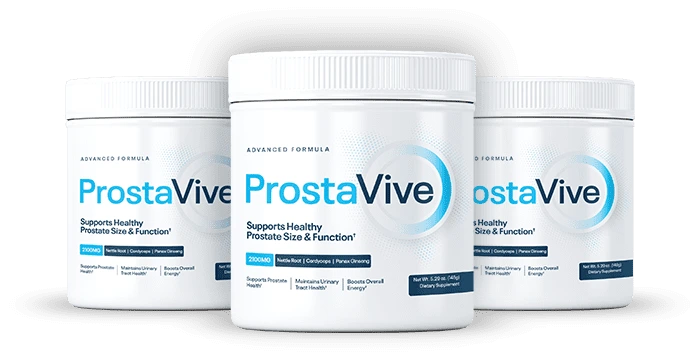
Our full ProstaVive review works through that on a real label: which ingredient leads the 2100 mg blend, what the label prints and what it leaves out, and how long the money-back window runs. It is a nettle-led formula, which puts it in the six-month research bracket rather than the eight-week one.
Does the refund window cover a fair trial?
We check the lead ingredient, the blend, what the label leaves out, and how long you actually get to judge it before the guarantee closes.
Read the full ProstaVive review, label and dosesWhat should I plan for over a 90-day run?
Set it up once, at the start, so that in twelve weeks you have an answer instead of a shrug.
- Buy for the full window. A single month is not a test. Work out what 90 days costs before you start, not in week five.
- Check the guarantee outlasts the run. Read the refund terms at checkout. A window shorter than your trial period cannot protect the trial.
- Take it at the same time daily. Consistency is what every one of these trials measured. Attach it to something you already do.
- Change one variable at a time. If you start a supplement, cut caffeine and begin exercising in the same week, you will not know which one did anything.
- Keep the four scores on one note. Weeks 0, 4, 8 and 12, on your phone, with dates.
- Keep the target realistic. The measured outcomes are urinary flow, bladder emptying and symptom scores. None of these ingredients was shown to make the gland smaller.
- Stop and see a doctor if anything new appears: blood in the urine, pain, fever, or an inability to urinate.
For the ingredient-by-ingredient evidence behind these timelines, see which prostate supplement ingredients have real clinical evidence behind them, or browse our men's health supplement reviews for individual products.
Frequently asked questions
How long before I notice anything from a prostate supplement?
Most of the research points at 8 to 12 weeks for a change large enough to show up on a symptom score. The beta-sitosterol trials ran 4 to 26 weeks, the pygeum studies averaged 64 days, and the nettle root trial ran six months. Anything promising a result in days is marketing rather than physiology.
Should I stop if nothing has happened in 30 days?
Thirty days is shorter than the average study in this category, so it is a weak basis for a decision. The more useful move is to check you took a written baseline score, keep going to week eight, and re-score then. If you did not take a baseline, start one now and give it eight weeks from today.
Does taking more of it speed things up?
The best evidence says no. The CAMUS trial gave 369 men double and then triple the standard saw palmetto dose across 72 weeks, and the higher amounts did not beat placebo any more than the standard one did. Stay at the labelled serving. More is not faster, and with minerals such as zinc, more over long periods carries its own downsides.
What if my symptom score gets worse?
Book an appointment. A score that climbs while you are doing everything right is a reason to be assessed in person rather than a reason to switch products. The same goes immediately for blood in the urine, pain, fever, or being unable to urinate at all.
Sources
- Wilt T, Ishani A, MacDonald R, Stark G, Mulrow C, Lau J. Beta-sitosterols for benign prostatic hyperplasia. Cochrane Database of Systematic Reviews. 2000;1999(2):CD001043. 519 men across 4 randomised placebo-controlled trials lasting 4 to 26 weeks; symptom score difference 4.9 points; peak flow +3.91 mL/s; residual volume 28.62 mL; no change in gland size. pubmed.ncbi.nlm.nih.gov/10796740
- Wilt T, Ishani A, Mac Donald R, Rutks I, Stark G. Pygeum africanum for benign prostatic hyperplasia. Cochrane Database of Systematic Reviews. 2002;1998(1):CD001044. 18 randomised trials, 1,562 men; mean study duration 64 days, range 30 to 122 days; nocturia reduced 19%, residual volume 24%, peak flow increased 23%. pubmed.ncbi.nlm.nih.gov/11869585
- Safarinejad MR. Urtica dioica for treatment of benign prostatic hyperplasia: a prospective, randomized, double-blind, placebo-controlled, crossover study. Journal of Herbal Pharmacotherapy. 2005;5(4):1-11. 620 men over six months; symptom score 19.8 to 11.8 versus 19.2 to 17.7 on placebo; peak flow +8.2 mL/s versus +3.4 mL/s. pubmed.ncbi.nlm.nih.gov/16635963
- Barry MJ, Meleth S, Lee JY, et al; CAMUS Study Group. Effect of increasing doses of saw palmetto extract on lower urinary tract symptoms: a randomized trial. JAMA. 2011 Sep 28;306(12):1344-51. 369 men, doses up to three times the standard 320 mg per day over 72 weeks; symptom score fell 2.20 points versus 2.99 points on placebo. The three-point improvement threshold for a clinical responder is reported in the Cochrane analysis of this trial. pubmed.ncbi.nlm.nih.gov/21954478
- Barry MJ, Fowler FJ Jr, O'Leary MP, Bruskewitz RC, Holtgrewe HL, Mebust WK, Cockett AT. The American Urological Association symptom index for benign prostatic hyperplasia. Journal of Urology. 1992 Nov;148(5):1549-57. The seven questions covering frequency, nocturia, weak urinary stream, hesitancy, intermittence, incomplete emptying and urgency. pubmed.ncbi.nlm.nih.gov/1279218
- Franco JVA, Trivisonno L, Sgarbossa NJ, Alvez GA, Fieiras C, Escobar Liquitay CM, Jung JH. Serenoa repens for the treatment of lower urinary tract symptoms due to benign prostatic enlargement. Cochrane Database of Systematic Reviews. 2023 Jun 22;6(6):CD001423. IPSS range 0 to 35, higher scores indicate worse symptoms; moderate band 8 to 19; a mean difference under one point described as little to no difference. pubmed.ncbi.nlm.nih.gov/37345871

About the author: Ray Delgado
I'm Ray Delgado. I hit my mid-forties, started paying attention to the health questions men my age actually ask, and went looking for straight answers. The clearest ones were sitting in the research, so I started reading the actual studies, and then writing this: plain-English breakdowns of what the research shows on prostate and men's health supplements, what the labels leave out, and what is worth paying for. No fear-mongering, no miracle cures.
Not medical advice. I am not a doctor, urologist or pharmacist. Updated 8 September 2026. This article contains links to our review pages, which carry affiliate links.
Affiliate disclosure: some links on this site are affiliate links. If you buy through one of our review pages we may earn a commission, at no additional cost to you. This does not affect what we write or which studies we cite. This article is general information, not medical advice, and it is not a diagnosis. Statements about dietary supplements have not been evaluated by the Food and Drug Administration, and supplements are not intended to diagnose, treat, cure or prevent any disease. Talk to a doctor before starting a supplement, especially if you take medication or have a health condition, and get any urinary or prostate symptom assessed in person.